Atlantic & Canada Adventure 1961 |
|---|
| Text by Art Peterson; all photos by J.W. Vigrass; from the Krambles/Peterson Archives, except as noted. |
During the summer of 1961, Bill Vigrass planned a trip with friend Bill Garrison to
escape the heat and humidity of Cleveland for the cool climate of Atlantic Canada (concentrating
on New Brunswick, Newfoundland, Nova Scotia and Prince Edward Island). This trip occurred right
as CN was in process of revamping its image, introducing Alan Fleming's famous "noodle" logo.
It would be a while before the image was applied (beyond experimental applications) to locomotives
and rolling stock in quantity. In that summer of '61, the designer hoped the new image would
last for 50 years; the image has been with us for 64 years and still looks stylish.
CN still ran a lot of service (first class and mixed trains) in the Atlantic Provinces and was
only a year past the dropping of the fires on its last steam locomotives. "The two Bills"
found a lot of variety in the motive power in charge of the services in these parts. This
piece celebrates some of that variety. Although they recorded action on the CP and other
carriers, to keep the length manageable, this article concentrates solely on some of the CN
action they documented.
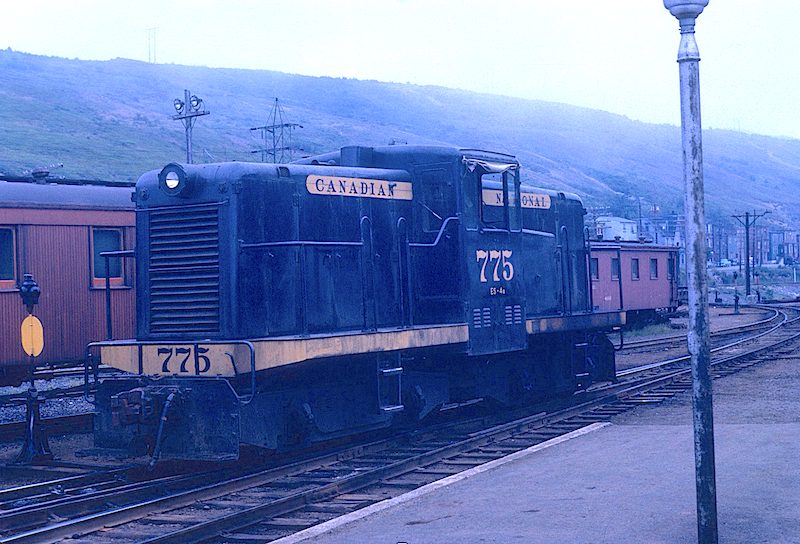
The world population of 47-ton GE dropcabs was less than 50 units. The bulk of these were
narrow gauge, including the three 42" gauge units for Newfoundland. BTW, Trans-Canada Airlines'
(TCA) Vickers Viscounts had taken "the two Bills" from New York to Halifax (via Boston) and then
from Halifax to St. John's on July 22nd. TCA (a CN subsidiary) was founded in 1937; in 1965
it became Air Canada.
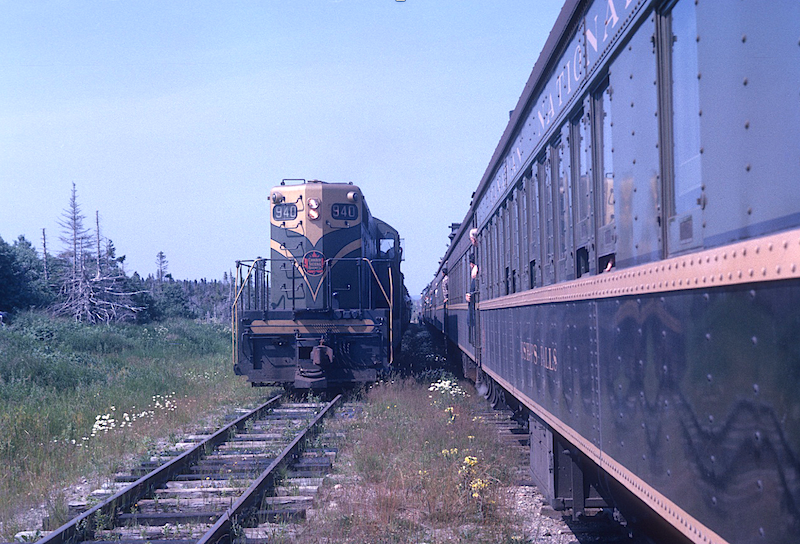
The 940 would go on to serve CN successor (of the Newfoundland railways operation from April
1980) Terra Transport. Retired in 1989, today the engine can be found at the museum in
Whitbourne, NFD. Bill's notes on Train 1's consist indicate that there were two 900s pulling
a 12-car train, including coaches, a diner and a few 8 Section-1 Drawing Room sleepers (all
non-air-conditioned).
blank, blank, blank, blank, blank, blank,
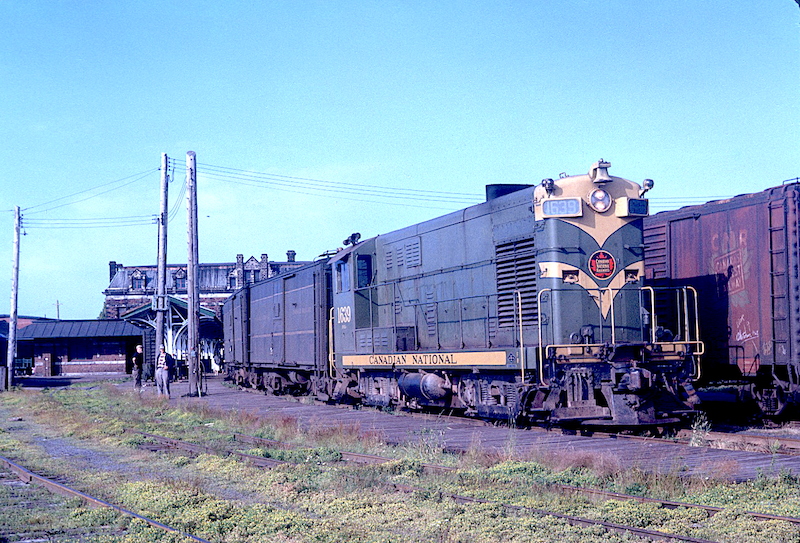
Train 39 provided only coach accommodation (also transporting a baggage car, an RPO and the
express boxcars shown behind the 1639) and was scheduled to take 3 hours and 35 minutes to
cover the 53.4 miles from Charlottetown to Borden. The consist was transferred to a CN ferry
to make the 9.5-mile crossing of the Northumberland Straight and then would resume its rail-borne
journey, tying up in Moncton, NB at 1:40 pm.
The backdrop for this shot is a portion of the Richardson Romanesque-style Charlottetown CN
station, which opened in July 1907. The building still stands at the corner of Water & Weymouth
Streets, although now repurposed.
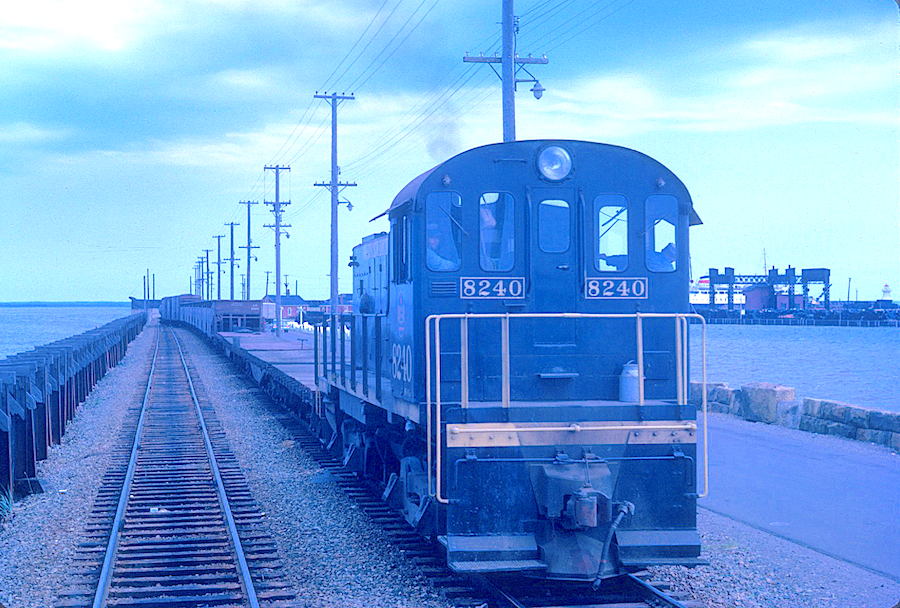
"MV Abegweit" began service on the New Brunswick-Prince Edward Island crossing (acting as an
ice-breaker, in addition to performing the ferry duties) from August 11, 1947. The ship had
a capacity of 19 railroad cars, 60 autos and 950 passengers. Canadian rail de-regulation led t
o the abandonment of the Prince Edward Island rail network, with the last train running on
December 28, 1989. The Confederation Bridge (opened on the last day of May 1997) superseded
the ferry service. Today, the "MV Abegweit" is the property of the City Yacht Club in Chicago.
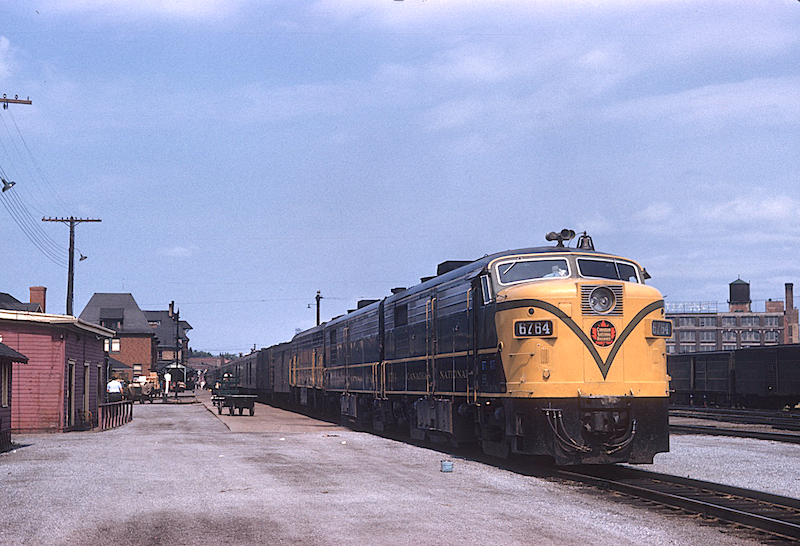
FPA4 6764 served for both CN and then Via (into 1989) before joining the roster of the NY&LE.
Not long after this photo, CN selected the "Ocean Limited" to experimentally operate the passenger
cars demonstrating its new image.
During the course of their summer 1961 trip, "the two Bills" managed to rack up 1,844 miles
using CN trains, along with almost 117 miles on CN ships.
Acknowledgements: Without Bill's notes on the trip, this piece would
not have been possible. In addition, several websites, along with "Trains" and "X2200S" were
used to prepare this piece. Craig also helped with the roster details.
|
| New: 1 July 2022 |