What's In A Name? South-Southeast EditionAll photos from the Krambles-Peterson Archive
Text by Art Peterson |
|
|---|---|
Use of distinctive names to identify the premiere train(s) on a route did not come into practice until nearly two decades after passenger trains first began operating in the US. The 1847 naming of the "Fall River Boat Train" is credited with beginning this practice, which reached its zenith around the time of World War One. As Bill Kratville noted in his superb book "Steam, Steel and Limiteds" these train names would become "household words." Thanks to the publicity skills of George Henry Daniels (and others), names like the "20th Century Limited" immediately suggested the notion of luxury, fine dining and the scenery of the water level route. The same was true of the many other fine named trains of the era. Even into 1950, the US still boasted some 350 name trains in operation. This series celebrates those once-familiar name trains on a regional basis. Each installment includes five trains, with the photos presented in chronological order. Since this feature is appearing on "The Diesel Shop" site, it also includes a variety of the diesels that were once in command of the name trains. Apologies if your favorite road/limited/locomotive model isn't included in this series. |
|
ACL E6m 511 "West Coast Champion" - Winter Park, FL - April 1952 - WB Cox Photo
ACL remained decidedly pro-passenger throughout the 1950s (including the transition in
leadership from Champion Davis to Tom Rice). Passenger revenue in the first 10 months of 1956
was up 6.6% compared to the same period for 1955. In 1958, the road reported that the "East
Coast Champion" was its top earner, grossing $9/mile. The "West Coast Champion" was no slouch,
grossing $7/mile. It was not uncommon to find 20-car consists operating on these trains.
Turn your attention to E6m 511 heading the train this day. It began life as a normal E6,
(S/N 1151, built 12/40). However, on November 27, 1950, this unit's life was decidedly changed
in a head-on collision with a freight in Screven, GA. The impact of the collision raised the
511 off its rear truck, while both ends of the locomotive were significantly crushed in the
collision. Subsequently, the unit caught fire doing further damage to it, along with the first
two cars of the passenger train and the nearby depot. The ICC's October 11, 1951 report on the
accident could not determine the cause.
ACL rebuilt the 511 to the functional equivalent of an E8 and it returned to service about a
month prior to this photo.
|
|
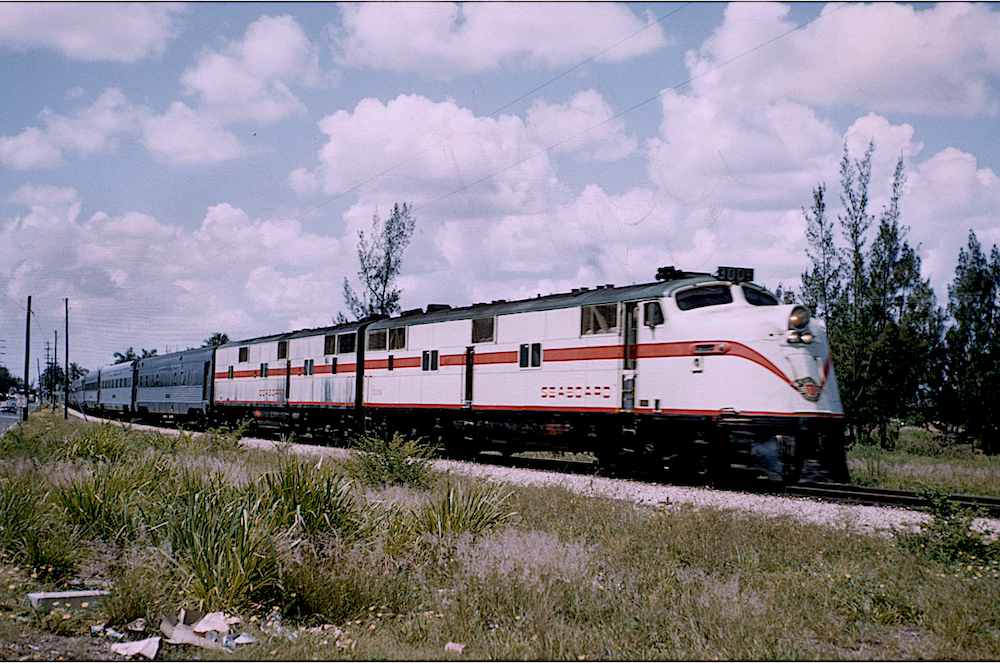
SAL E4 3009 - "Silver Meteor" - NB Palm Beach, FL - 1956
Seaboard chose the "Silver Meteor" name out of 76,366 entries it received. The train (the
first diesel powered streamliner on the New York-Florida run) began operating in February 1939
as a 7-car train. By the time of this unattributed photo, the consist routinely stretched to
18 cars (including the then-new sun lounge cars) and there were both east and west coast sections
of the train in operation, attesting to its status as SAL's flagship name train.
Commensurate with a named limited, the "Meteor" could still roll of the miles at a fast clip.
The 1957 "Trains" speed survey recorded an average speed for the "Meteor" of 70.6 mph for the
61.2 miles from West Palm Beach to Okeechobee. From Okeechobee to Sebring (41.4 miles), Train
58 was scheduled to average 70.8 mph.
E4 3009 had been built in December 1939 (S/N 962). SAL retired the unit in September 1964.
|
|
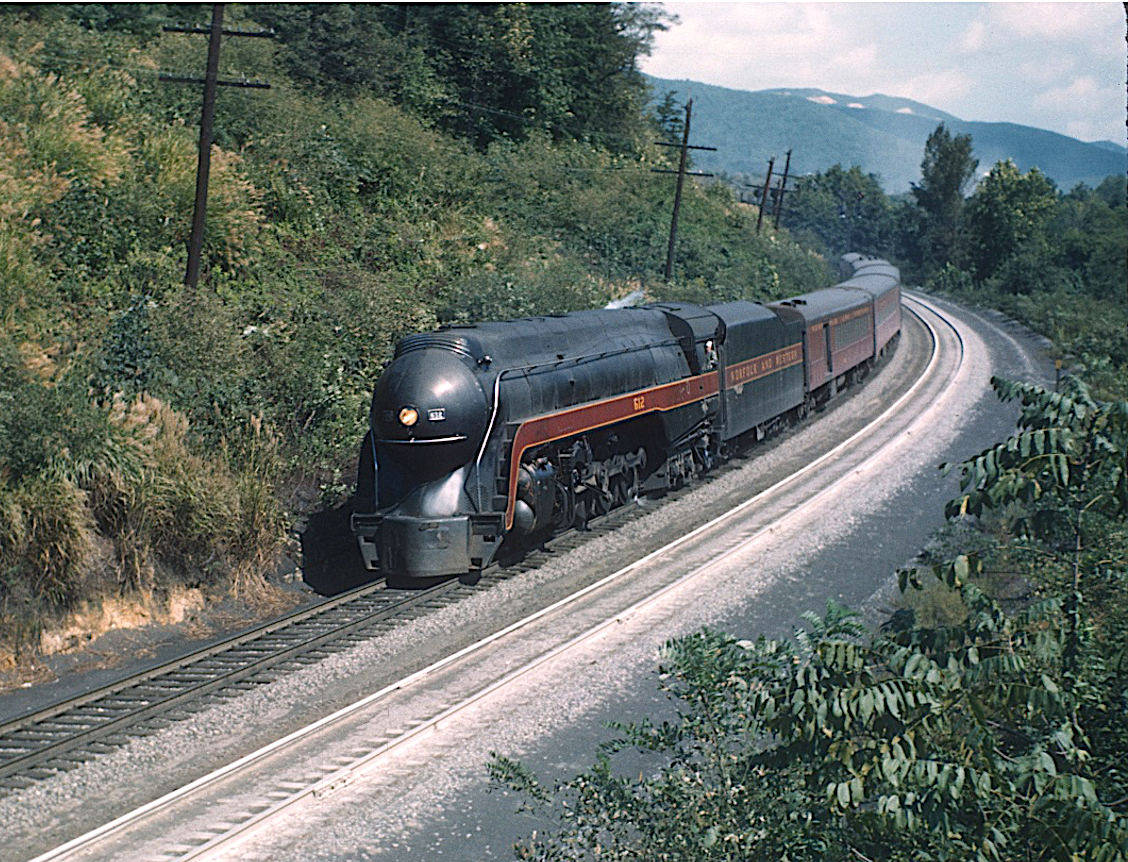
N&W J1 612 "Powhatan Arrow" - WB Webster, VA - ca. 1957 - J Schmidt Photo
N&W's J- and J1-class Northerns were exceptional locomotives in every regard, offering a
handsome combination of speed and power. The 612 (built in August 1950) was a member of the
3-locomotive final build for Class J1 locomotives, which joined their 11 sisters on the point
of N&W's crack trains on the Norfolk-Cincinnati run. This engine was retired during 1959.
Operation of the "Powhatan Arrow" began on April 28, 1946. That same year, the road placed
the $2 million order for the Pullman-Standard-built streamlined cars that would enter service
on the train from 1949. In Jim's view the train still has the tavern-lounge-obs on the rear.
These cars were withdrawn in the spring of 1958 and later sold to Saudi Arabia. That was also
the year that N&W leased diesels from ACL and from RF&P, at which time operation of the J-J1s
was superseded.
As the "last stand of high-speed steam," N&W gave the J-J1s a good send-off. In 1956, the
"Arrow" was scheduled to cover the 58.9 miles from Suffolk to Petersburg at an average speed
of 65.4 mph. For the 1957 "speed survey,"" the train's schedule had been tightened to require
it to average 66.7 mph over those same 58.9 miles.
|
|
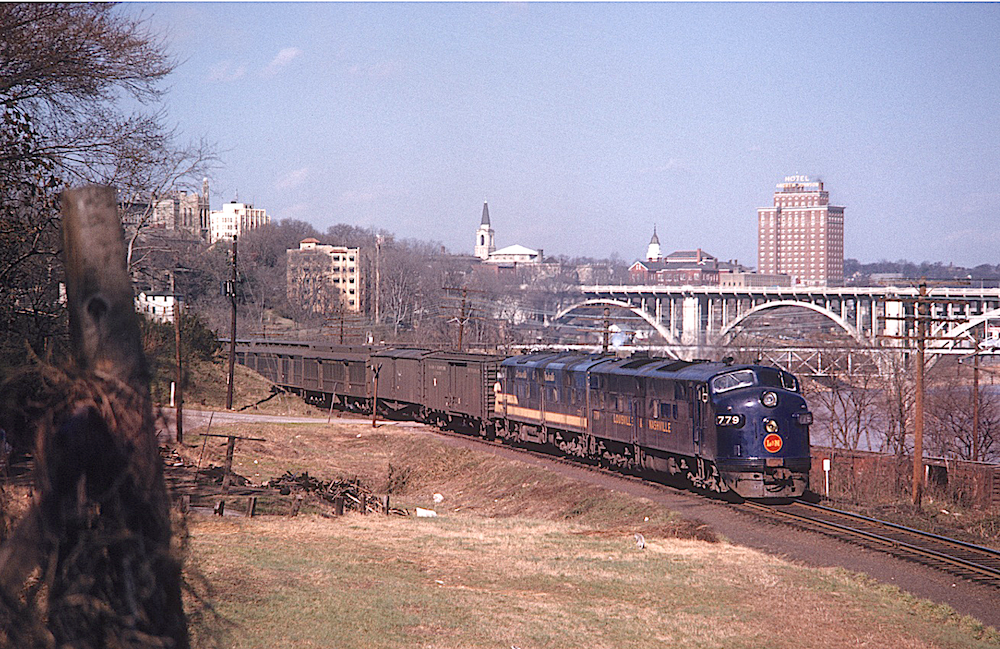
L&N E7 779 "Southland" - SB West Knoxville - ca. March 1959
Operation of "The Southland" dated back to November 21, 1915, when the "South Atlantic
Limited" was renamed and extended to become a Chicago-Jacksonville train running via the
PRR-L&N-CofG-ACL. There was a brief stint (from December 11, 1935 until November 7, 1938)
where the train operated under "The New Southland" banner. This change coincided with
shortening the trip time by 3-4 hours (faster running in the south, along with an adjustment
of arrival and departure times in Cincinnati).
Postwar, "The Southland" was one of the second-tier trains on the Chicago-Florida run. Hit
hard by the recession in 1957, "The Southland" was reduced from December 1, 1957 to a
Cincinnati-Atlanta run, connecting to the "Dixie Flyer" in Atlanta.
The terrain, foliage and a fair contingent of head-end cars hide the fact that by the time of
this photo passenger accommodations on "The Southland" were down to a single coach. A
"rolling buffet service" (food cart) was instituted on this train from April 27, 1958 until
its discontinuance on July 25, 1959.
|
|
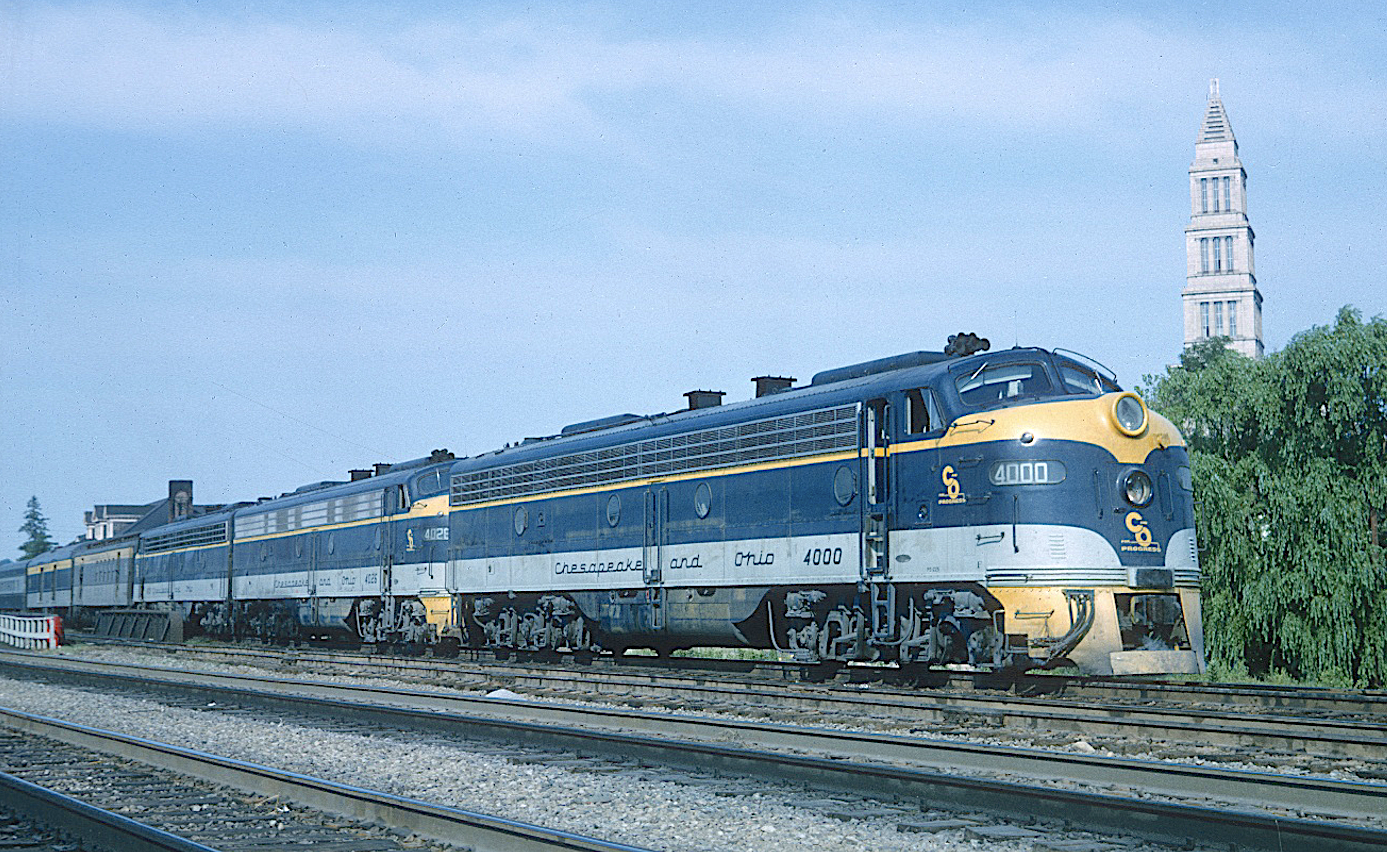
C&O E8 4000 "George Washington" - NB Alexandria, VA - July 21, 1966
Known as "George Washington's Railroad" (for its role in linking Virginia to the western
waters), it's entirely logical that C&O would make the "George Washington" its premiere train.
Begun on April 24, 1932 and air-conditioned from the first, the train also commemorated the
200th anniversary of Washington's birth.
On July 21, 1966, the US was 14 days into what would finally stretch out to be a 43-day airline
strike. C&O/B&O (under C&O control since 1963) saw the strike as an opportunity to showcase
their trains and service. In November of 1966 "Trains" reported that the two roads had seen
their passenger loads boosted by 5,000 riders/week.
C&O/B&O obviously hoped to hang onto those new riders, but it was not to be. In the summer of
1966, the "George" had boasted five sleepers as it headed on its final lap into DC. Two years
later, the train required just a pair of sleepers. On top of that, C&O had discontinued both
the "FFV" and the "Sportsman" from May 12, 1968.
|
|
Acknowledgements: As noted in the introductory text, Bill Krattville's "Steam, Steel & Limiteds" was a valuable resource; as was Fred Frailey"s "Twilight of the Great Trains." Chuck Blardone's book on the Midwest-Florida train service and Tom Dixon's books on the C&O passenger services were also of considerable use. Back issues of "Trains" magazine and "X2200S," along with numerous websites were also consulted. In addition, Phil Gosney and Craig Rutherford each provided specific operating/equipment info.
|